
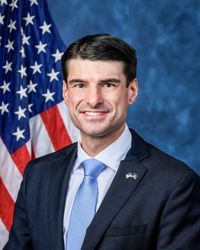
Robert P. Bresnahan, Jr.
RepublicanRepresentative, PA District 8

House rejects Iran War Powers Resolution
The House rejected a resolution that would have required President Trump to seek congressional authorization before continuing military operations in Iran. The vote came six days after the U.S. and Israel launched strikes on Iranian nuclear facilities. Two Republicans (Massie, Davidson) voted yes with Democrats; four Democrats (Golden, Landsman, Cuellar, Vargas) voted no with Republicans.
House passes DHS funding bill without ICE reforms
The House passed H.R. 7744, the Department of Homeland Security Appropriations Act, 221-209. The bill would fund DHS for the remainder of fiscal year 2026 with no conditions on ICE enforcement. Four Democrats voted yes; all Republicans voted yes. Democrats had demanded reforms including body cameras, ID requirements, and judicial warrants for ICE arrests on private property. None were included.
Save American Voter Eligibility (SAVE America) Act (House vote)
This is a bill to require documentary proof of citizenship—such as a passport or birth certificate—to register to vote, plus photo ID to cast a ballot. Non-citizen voting is already illegal and extremely rare. When Kansas implemented a similar requirement, it blocked over 31,000 eligible citizens from registering while catching just 39 non-citizens over 14 years. Research shows more than 21 million American citizens lack ready access to citizenship documents—disproportionately affecting people of color, young voters, married women whose names don't match their birth certificates, and low-income Americans. The bill now faces a steep climb in the Senate, where Republicans lack the 60 votes needed to overcome a filibuster. Majority Leader Thune declared the "talking filibuster" approach dead after Senate GOP confirmed the votes aren't there.
Department of Homeland Security Appropriations Act, 2026 (House vote)
This was a bill to fund the Department of Homeland Security for FY2026, including immigration enforcement agencies and FEMA. After federal immigration agents shot and killed two U.S. citizens in Minneapolis, some lawmakers demanded reforms—including body cameras, a ban on agents concealing their identities with masks, and judicial warrants for arrests. The administration refused. The bill passed the House, but [failed in the Senate](https://complicitynavigator.com/v/jpz4wt).
Continuing Appropriations Act
Congress passed H.R. 5371 to end the longest government shutdown in US history (43 days). The bill funds most federal agencies through January 30, 2026, including DHS and ICE operations. Senate Democrats had demanded ACA subsidy extensions, but seven Democrats and one independent sided with the President. Six House Democrats sided with the President.
One Big Beautiful Bill Act
H.R. 1, the One Big Beautiful Bill Act (P.L. 119-21). President Trump's signature budget reconciliation bill, extending his 2017 tax cuts while cutting nearly $1 trillion from Medicaid and imposing new work requirements for food stamps. The bill provides $75 billion in supplemental funding for Immigration and Customs Enforcement through FY2029—nearly tripling ICE's annual budget—including $45 billion for detention capacity expansion to 100,000 beds and $29.9 billion for enforcement operations and 10,000 new officers. The Senate passed the bill 51-50 on July 1, 2025, with Vice President Vance casting the tie-breaking vote after three Republicans—Susan Collins (ME), Rand Paul (KY), and Thom Tillis (NC)—joined all Democrats in opposition. The House concurred 218-214 on July 3, with Republicans Thomas Massie (KY) and Brian Fitzpatrick (PA) voting Nay. Signed into law July 4, 2025.
Full-Year Continuing Appropriations and Extensions Act, 2025
This bill kept the federal government funded through September 2025, freezing spending at 2024 levels while cutting $13 billion from non-military programs. Senate Democrats faced a painful choice: block the bill and risk a shutdown that would give President Trump and DOGE free rein to decide which agencies stay open, or let it pass with no oversight concessions. The outcome was decided in the Senate cloture vote, where ten Democrats broke the filibuster 62-38. After that, the final vote only needed a simple majority. The House passed 217-213; the Senate passed 54-46.
Laken Riley Act
The first law signed in President Trump's second term, the Laken Riley Act requires mandatory detention of undocumented immigrants who are arrested for, charged with, or admit to committing theft, burglary, larceny, shoplifting, assault on a law enforcement officer, or any crime resulting in death or serious bodily injury. It also allows state attorneys general to sue the Department of Homeland Security over immigration enforcement failures. The Senate passed it 64–35 with 12 Democrats crossing over; the House passed it 263–156 with 46 Democrats voting yes.